
Road to ETX · Part 2 of 5
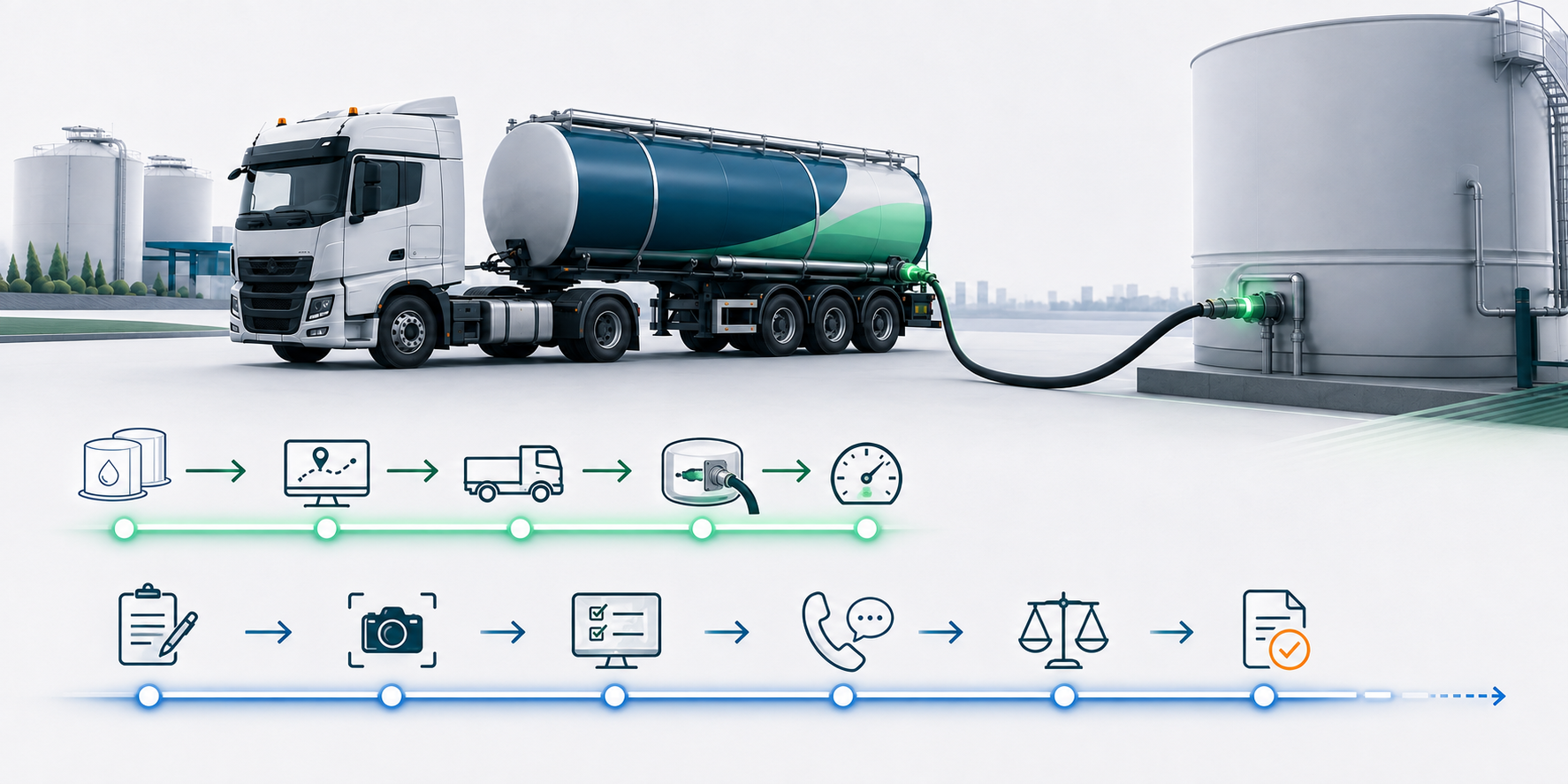
The product is in the tank and the truck is on its way. Commercially, the delivery may only have begun. Part 2 of 5 asks why a delivery can end in minutes at the customer and remain open for weeks in the office.
By Secu-Tech
One afternoon, the physical work is complete. The hose has been disconnected, the delivery ticket has been produced and the tanker is moving to the next stop.
Weeks later, the same delivery is open again.
A quantity has been queried. The customer has a photographed ticket. The office has a record from the order system. The measured value sits in another source. Someone asks the driver what happened, but the route now contains dozens of later stops and the details are no longer fresh.
Nothing about this situation is dramatic in isolation. It is a familiar email thread, a short call, a copied attachment and perhaps a credit note. Yet it shows a fundamental divide between the physical delivery and the commercial transaction.
The physical event ends when the product has moved safely. The commercial event ends only when order, measured quantity, delivery record, customer acknowledgement and invoice agree.
Four records are not the same as one event
Many processes create several records around one delivery. That is not automatically a problem. Different systems have different legal, technical and business responsibilities.
The problem begins when the records have to be reconstructed manually because they do not share a clear event identity or enough common context.
A ticket may show the quantity. The planning system knows the order. The vehicle knows the compartment and product. The customer has a signature or a query. If these pieces cannot be brought together quickly, a straightforward question becomes an investigation.
Late questions are especially expensive because context decays. The people who were present move on. The vehicle continues its route. A temporary exception may not be visible in the final document. The longer a transaction remains open, the more work is required to rebuild what was obvious at the delivery point.
This is not simply a paperwork problem. It is a process-design problem.
The record should begin when the event happens
A better model starts with one operational event that produces consistent information for the systems around it. That does not mean forcing every system into one database. It means ensuring that the delivery can be recognised as the same event across metering, vehicle, customer proof and office processing.
The distinction matters. A large central system can still receive incomplete or ambiguous data. A modest local system can create valuable continuity if the event is captured clearly, linked to the right context and passed onward through defined interfaces.
Traceability also requires restraint in language. No industrial event record should be called legally immutable or “court-proof” without specific technical and legal validation. The practical target is clearer: relevant process, status, operator and diagnostic information should be available for reconstructing what happened.
For the driver, this reduces the need to explain old stops from memory. For the office, it reduces the time spent matching documents. For the customer, it shortens the path from question to answer.
Closing the business event
The most useful performance question may therefore not be how quickly the hose is disconnected. It may be how quickly the delivery becomes a closed, consistent business event.
Ask:
- Can the order, vehicle, product, quantity and proof be associated without manual detective work?
- Is an exception recorded with enough context to be understood later?
- Can the office see the same event that the driver completed?
- Does a customer query begin with shared facts or with four competing documents?
The delivery should not have two endings: one at the customer and another weeks later in administration.
Secu-Tech will show its answer at ETX in Kassel from 17 to 19 September 2026.
About Secu-Tech: Secu-Tech has developed electronic systems for the safe handling, monitoring and documentation of liquids and gases in Leobersdorf, Austria, for more than twenty years.