Road to ETX · Part 1 of 5
Fuel logistics has digitalised its planning, routing and billing. Then the truck arrives, and the most important ten metres of the supply chain can still depend on paper, memory and phone calls. Part 1 of 5 on the gaps between capable systems, and what closing them would change.
By Secu-Tech
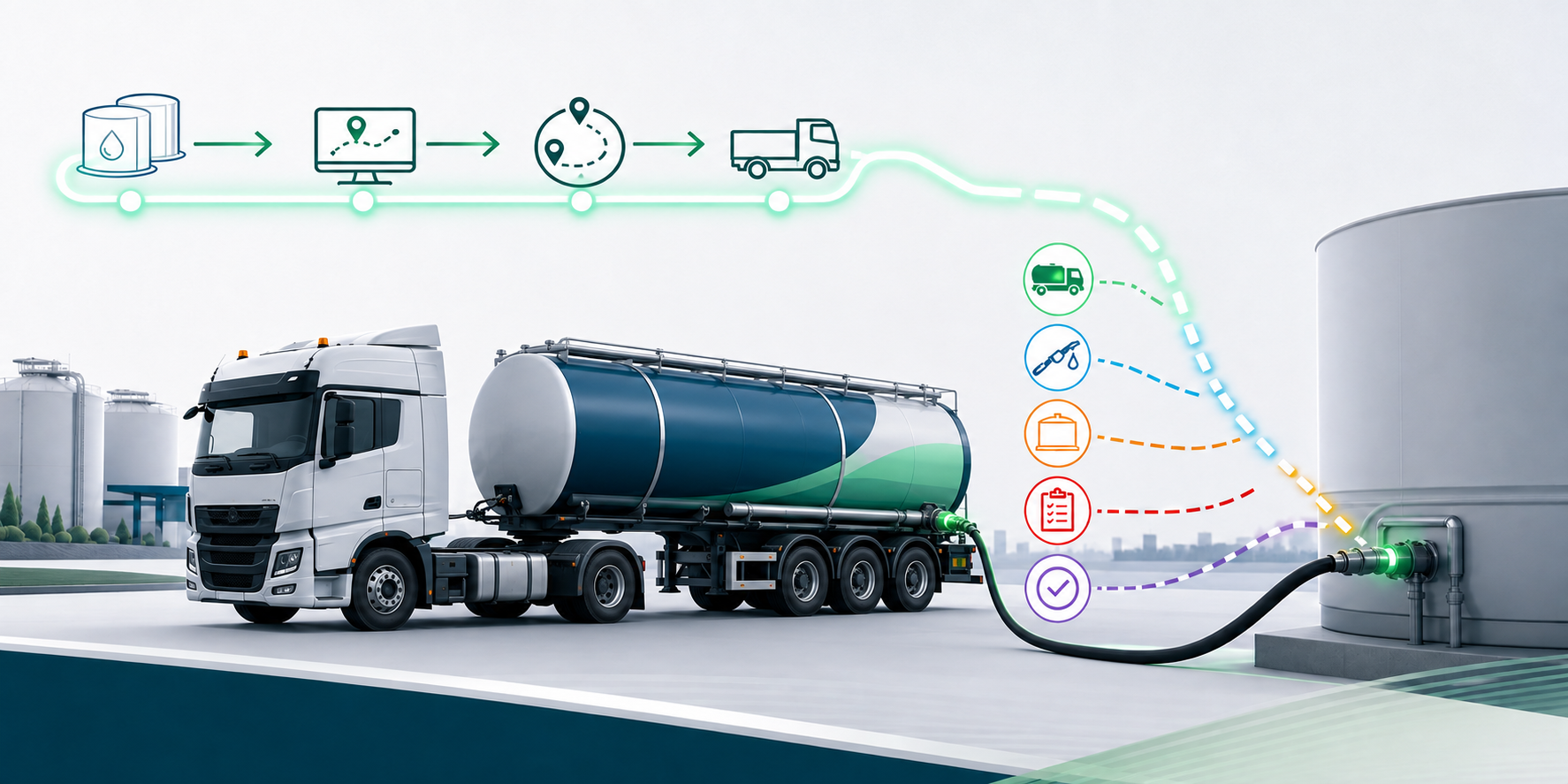
A dispatcher watches a tanker move across a map. The route is planned, the vehicle is on time and the customer is expecting the delivery. Data has already passed through an order system, a planning tool and the vehicle’s telematics.
Then the dot stops at the delivery point.
From the office, the last ten metres can become strangely quiet. The hose is connected. Access to the tank is checked. Product moves. A measured quantity is produced. A ticket is issued and a signature is collected. These are the moments in which product, customer and proof finally meet, but they are also the moments most likely to disappear between systems.
The journey to the customer may be visible almost minute by minute. The delivery itself can still rely on a person reading one screen, entering a number into another device, explaining an exception by phone and carrying a paper record back into the billing process.
Each individual step may work. The meter measures. The vehicle system controls. The driver knows the procedure. The office software creates the order and invoice. The problem is not necessarily a weak component. It is the handover between capable components.
The gap is small at one stop and large across a network
At a single delivery, copying a value or making one clarification call may not look significant. Repeated across every stop, route and working week, these small breaks become an operating model.
They consume driver time, but the cost does not remain with the driver. Dispatch waits for an answer. Customer service explains a delay. Administration reconciles a ticket. Service personnel try to understand whether an interruption was caused by process, equipment or missing information.
Significant operational losses can accumulate in these ordinary transitions. They are difficult to see because no single system records the whole cost.
This is why “more data” is not a sufficient answer. A vehicle may produce large amounts of data and still leave the decisive delivery context fragmented. What matters is whether order, vehicle, product, metering event and proof remain connected as one operational sequence.
Continuity has to reach the delivery point
A connected process does not mean that every function must depend on a permanent network connection. Local operation remains essential on a vehicle. Connectivity should preserve context, support synchronisation and make the right information available to the people who need it without making the physical delivery dependent on ideal reception.
It also does not mean replacing every working component. Many fleets operate mixed vehicle generations and supported equipment from different suppliers. Continuity has to begin with the installed environment, not with the assumption of a completely new fleet.
The useful question is therefore not “How digital is our logistics chain?” It is more specific:
Does the delivery remain one process from the order to the proof, or does it dissolve into disconnected moments in the last ten metres?
That question affects fleet operators, vehicle builders, system integrators and forecourt operators alike. Each sees a different part of the handover. None can solve it alone if the systems around the delivery were never intended to share enough context.
Over the coming weeks, this Road to ETX series will examine four of these operational gaps: the last ten metres, the paperwork that remains after the delivery, the integration decisions taken upstream and inherited by the site receiving the delivery, and the cost that keeps moving when a system stops.
Secu-Tech will show its answer at ETX in Kassel from 17 to 19 September 2026.
About Secu-Tech: Secu-Tech has developed electronic systems for the safe handling, monitoring and documentation of liquids and gases in Leobersdorf, Austria, for more than twenty years.