Road to ETX · Part 3 of 5
By the time a delivery reaches a forecourt or depot, the decisions that determine how well it can be checked, matched and closed were taken months earlier, somewhere else. Part 3 of 5 asks what late integration costs the site at the receiving end.
By Secu-Tech
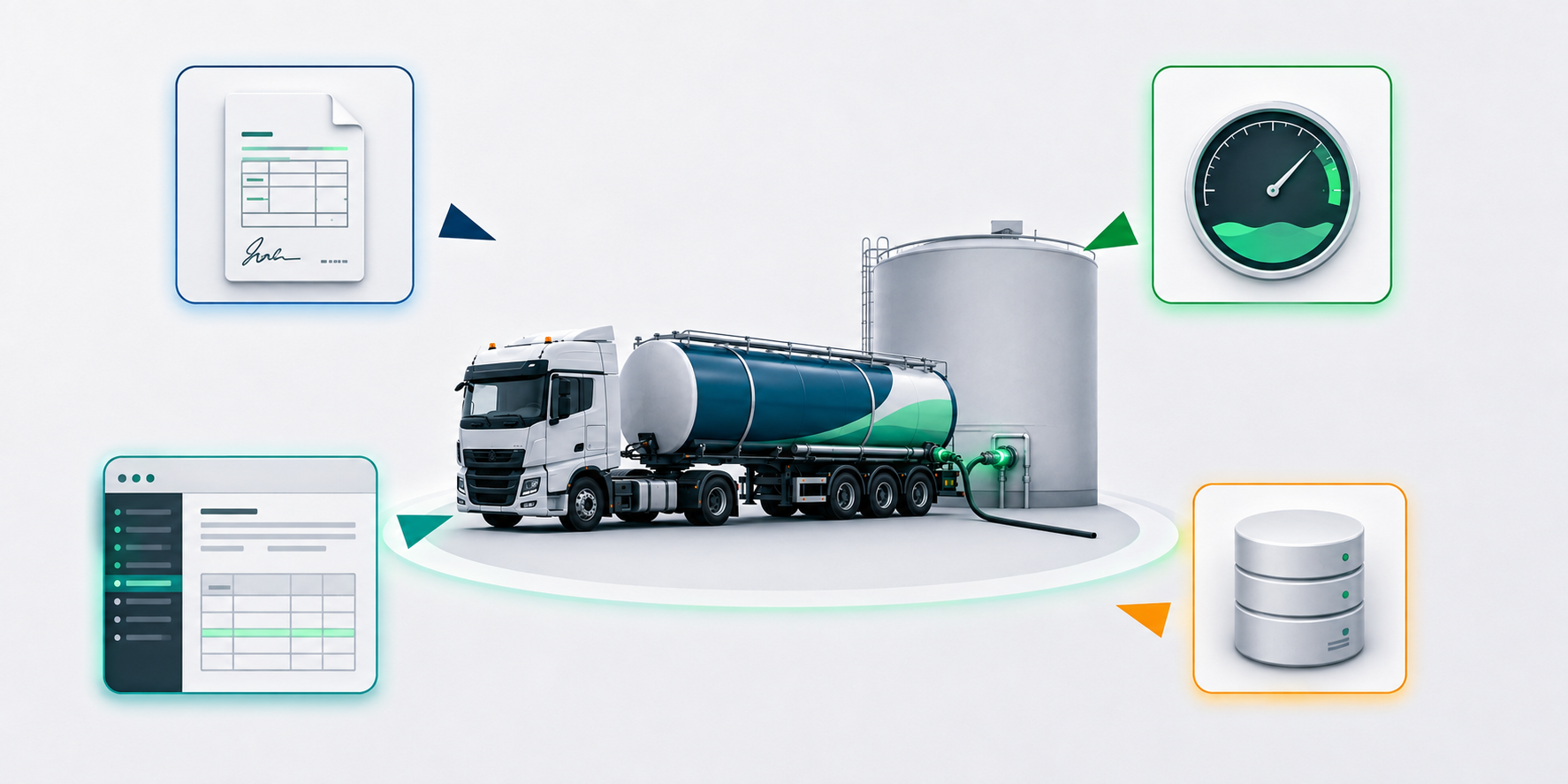
A tanker arrives at a site. Product moves into the tank. A ticket is produced. A gauge reading changes. Somewhere in a back-office system, a delivery is expected against an order.
Four systems have now described the same event, and none of them was chosen with the others in mind.
The tank gauge was specified when the site was built or last refurbished. The wet stock and back-office systems arrived with the retail group’s IT programme. The metering equipment on the vehicle belongs to the supplier, not to the site. Each was a sensible decision on its own day, made by a different person answering a different question.
The site was not at any of those meetings. It simply inherits the result, one delivery at a time.
The receiving end has no seat at the design table
Most integration discussion in this industry happens upstream. A vehicle builder decides what talks to what while a tanker is on the line. An equipment supplier decides which interfaces to document. A software vendor decides which formats to export.
The site is downstream of all of it, and its leverage looks small at the moment the hose is connected. But the site is where the consequences are counted, because it is one of the places where the physical delivery and the commercial record have to agree.
When the systems around a delivery were never intended to be combined, the site absorbs the difference. Someone reads a value from one screen and types it into another. Someone photographs a ticket because there is no other way to attach it to the right record. Someone calls the supplier because a number does not match and there is no shared view to look at together.
The site becomes the integration layer, in the same way the driver does on the road. It works, because people make it work. It also hides what weak integration actually costs.
Variance is where the cost surfaces
The clearest example is the difference between what was delivered and what the site believes it received.
A variance can have several ordinary causes: measurement conditions, temperature, timing between a gauge reading and a delivery, an entry made against the wrong tank, or a genuine discrepancy that deserves attention. Distinguishing between them is routine work when the underlying records share enough context, and an investigation when they do not.
The problem is rarely that the number is unknown. It is that the number exists in several places with no reliable way to connect them to the same event. Weeks later, the question is decided by whoever has kept the best notes rather than by the evidence.
That is not a metering problem or a software problem. It is an integration problem, and it was created before anyone at the site was involved.
Retrofit is where it is felt again
Sites change. A new tank goes in, a monitoring requirement appears, a group standardises on a different back-office platform, an operator wants delivery confirmation to reach the system automatically instead of by email.
At that point the question is no longer what the equipment does. It is what the equipment will share, and whether anyone documented it.
Where interfaces are documented and were intended to be combined, this is a project. Where they were not, it becomes a negotiation with the installed base, and an apparently inexpensive original decision can create disproportionate retrofit cost later.
This is also why claims of universal compatibility are unhelpful to a site operator. Nobody needs a supplier who says everything works with everything. What helps is a supplier who can say precisely which interfaces exist, what they carry, and what it would take to connect them here.
Questions worth asking earlier
The site cannot rewrite decisions taken upstream, but it can ask different questions before the next ones are taken, whether it is specifying equipment, agreeing a supply contract or approving a refurbishment:
- Which systems will describe this delivery, and can they be connected to one event?
- Which interfaces are documented and available, rather than theoretically possible?
- When a delivery does not match expectation, what evidence exists without a phone call?
- What can be added in three years without replacing what is installed now?
- Who is accountable for the gap between the vehicle’s record and the site’s record?
None of these questions is about a device. All of them decide how much routine friction a site lives with for the next decade.
The most useful integration question at the receiving end is therefore not whether the systems are modern. It is whether the delivery arrives as information the site can actually use, or only as product plus paper.
Secu-Tech will show its answer at ETX in Kassel from 17 to 19 September 2026.
About Secu-Tech: Secu-Tech has developed electronic systems for the safe handling, monitoring and documentation of liquids and gases in Leobersdorf, Austria, for more than twenty years.