When logistics costs increase, the impact ripples across the entire economy—from industry households. So far, government measures haven’t had the intended effect. The hard facts speak for themselves.
In times of crisis, it becomes evident what a functioning economy—and Germany’s prosperity—truly depend on: a secure and affordable energy supply. And that includes far more than just electricity. While much attention is given to the growing share of wind and solar power, electricity still accounts for only around a quarter of total energy consumption.
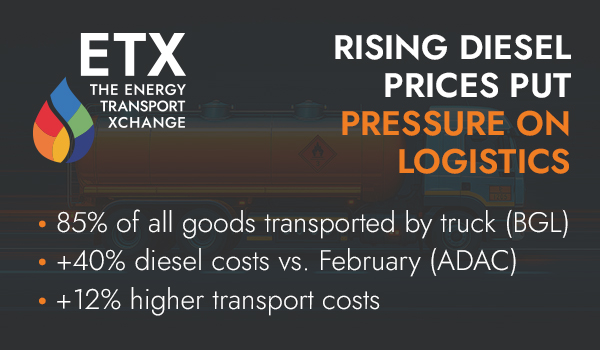
Just as crucial are fuel availability and prices. When costs surge, consequences are severe: After all, around 85% of all goods are transported by road.
According to calculations by the German Federal Association for Road Haulage, Logistics and Disposal (BGL), a 10% increase in diesel prices raises total costs by 3%, since fuel expenses account for roughly one third of overall expenses in the transport sector.
Applying this calculation to the current situation–with diesel at the pump being already about 40 % higher than the February average, according to ADAC—road transport costs rise by 12%.
As almost every product depends on road transportation, these price surges affect every sector of the economy. Economists such as Monika Schnitzer, Chair of the German Council of Economic Experts and Professor of Economics at LMU Munich, are warning that high oil and gas prices will “significantly dampen economic growth.” Ulrich Kater, Chief Economist at DekaBank, expects economic growth to decline by half a percentage point. Both assessments appeared in Das Parlament, the weekly newspaper published by the German Bundestag.
At the same time, it is still unclear how long the Iran conflict will last or how far it may escalate.
So far, government measures—such as allowing pump prices to increase only once per day—have failed to ease the situation. On the contrary, since the fuel measures package came into effect in early April, reports of new diesel price records have multiplied.
It should also be noted that the German government itself has played a significant role in driving up diesel prices in recent years. According to calculations by the BGL, around 47 cents per liter are attributable to the energy tax, approximately 20 cents per liter to CO₂ charges, and about 35 cents per kilometer to truck tolls—of which nearly 16 cents per kilometer stem from CO₂-related components. These factors apply independently of current market fluctuations, indicating that there is genuine potential for political measures to reduce logistics costs and thereby ease pressure on the broader economy. Nevertheless, it seems that the current strain on public finances leaves limited scope for such interventions.
And finally, for the sake of completeness: Various stakeholders are currently using the Iran crisis as an argument to accelerate the push for electrification in logistics. One key point overlooked, however, is that rising gas prices also drive-up electricity rates. This may not be immediately apparent short term—especially for private consumers with long-term contracts—but large industrial buyers procuring electricity on the spot market feel the effect straight away.
The root cause lies in the electricity pricing structure, the so-called merit-order principle. Under this system, power plants are dispatched in order of their marginal costs. If renewable capacities are insufficient, gas-fired power plants are brought online, ultimately setting the market price. As Germany has phased out—or plans to phase out—other generation capacities, new gas-fired plants are expected to secure electricity supply. As a result, the current dynamics of electricity pricing are unlikely to change anytime soon.